Thursday, December 16, 2010

Final Wellness Space Design


These are my final posters for my wellness space, I finally learned enough about Photoshop to figure out how to lay things out. (I'll have to work on this a lot more over our break) My concept for this space was to use the subtle colors (green, yellow, and white) in the Starry Night painting to create a calming tea room. I incorporated the curving shapes from the painting in the bar and soffit. The wall paper that is used behind the bar and booths also incorporates flowing curvilinear lines. (Poster 5 shows a close up of this wallpaper). In hind sight I probably should have had a more “flowy” furniture layout the layout I used is very grid like. At the time I felt that this would allow for the maximum seating.
I really enjoyed being able to use sketch up for this project seeing my space in a 3-D computer model was very helpful for me. Over break I want to work on my hand rendering more although I liked the renderings I did for this project I feel like I can still improve. Overall I enjoyed this project but am looking forward more to our office project next semester!

Poster 1

Poster 2


Poster 3


Poster 4


Poster 5


Tuesday, November 16, 2010

Process Presentation

Here are the first two poster for the Sustaining Wellness project. These posters are still under construction as I move along with the project. The first poster (above) displays my concept and wellness statements as well as the logo for my welness space and images of my concept model.
The second poster (below) shows a few of the materials I am considering using in the design along with an image of where I am in laying out the wellness space in autocad.

Monday, November 15, 2010

Proccess Work

Here are a few of the diagrams for the space planning portion of the Landor Office Project. I started off with relationship diagrams. I started this diagram below by looking at the main adjacency requirements in the program. Reading through the program the first thing I noticed was that the Executive Director needed to be directly adjacent to the Client Services Director, the Creative Services Director, the Finance Director and the Production Manager. After reading through the rest of the program I decided on where to put the rest of the team memebers  based of off the original five adjacencies and who would be working with those managers and directors.  

From the relationship diagram I moved onto some bubble diagram layouts. Again I started with the first five important adjacencies. I decided to put these executives and managers in the mezzanine level of the office space. This was so they would all be adjacent with each other as well as  be able to look over, and have reasonable access to  their team members on the level below.


 After figuring out the mezzanine level I began working on bubble diagrams for the lower level. The sketch below shows a block diagram of the main floor of the office space. The blocks represent the departments I was most sure about placing in the space.


The last space I began planning was my wellness space. After I decided I wanted my wellness space to be a tea bar I had a pretty good idea about how I wanted to lay it out so I drew a quick bubble diagram to give myself an idea of how the layout would work on paper.

I also made an elevation sketch of an idea I had for what I want the bar in my tea bar to look like.
These diagrams and sketches were a big help when I began laying out my project in AutoCad. Although they needed a few adjustments for the most part my layouts worked well in the spaces I decided to place them.


Wednesday, October 13, 2010

A Visit From Herman Miller

Recently a representative from Herman Miller came to speak to our class. Herman Miller is not only a leader in designing office furniture and systems but also a leader in companies going green. The representative informed us about many of the company’s office systems, furnishings and how the company creates products that are sustainable and well made.

Herman Miller's Green Factory in Zeeland, Michigan

Herman Miller makes chairs that are universal and comfortable for everyone. This means designing a chair that is comfortable for someone who is under five feet tall as well as someone who is over six feet tall.   They focus on support of the lower back when they design the back of their chairs the representative explained to us that to properly support the back the lower part of the back must be properly aligned with the rest of the back. We were told that each chair is designed to support the users back by adding extra support at the bottom.  They also consider that each person is different and they’re newer chairs are made to adjust to the pressure each individual puts on the back of the chair and conform to their body. I was very fascinated with their new SAYL Chair (pictured below) which was inspired by the Golden Gate Bridge. The material used in the back of the chair is flexible and conforms to the users back .this chair is unique in that it is frameless the “Y” backing of the chair holds up the top corners of the material and the bottom of it is stretched to the bottom corners of the chair.


SAYL Chair by Herman Miller
Herman Miller SAYL chair

All of Herman Miller’s products are sustainable and they use a cradle to cradle approach. In everything they make they consider how they can recycle the materials they use and whenever possible use materials that can be composted at the end of their useful life.  They also use designs that use fewer materials and are easy to ship in smaller packaging. (The SAYL chair is a good example of this)

The representative reminded us to consider “creep space” in our space planning using office systems. Creep space is the thickness of the partitions in the office systems. Although the walls aren’t very thick using many systems and not recognizing that extra few inches adds up greatly when you fill the room with systems furnishings. She also explained that office systems based off 120 degree angles work well when you have to design around obstacles such as columns because taking one portion of the system away doesn’t leave an odd gap and is more versatile than plain linear systems.

My Studio Environments Streetside with Open Door
Herman Miller's "My Studio" office system


This presentation was especially helpful to us because we will be using Herman Miller’s Resolve office system in our office project this semester. We were able to ask questions about this product. We learned that this system is pole based and to eliminate the clustering mess of electrical wires, the wires are run through the poles to help keep work stations less cluttered. This system is run off the 120 degree concept which means that they are extremely versatile and can fit in many different configurations. Also they have customizable panels which allow companies to use whatever images they choose (should they want to choose a specific image) to be printed on the panels.  At first glance I thought the overhead panels coming off the top of the poles looked very bizarre and I could not imagine why anyone would want them over their heads. The speaker explained that those panels are helpful in offices with very high ceilings to give workers a sense of scale in the room and not to feel uncomfortable in very tall surroundings.

Herman Miller Resovle System


Learning from China

The Chinese have a very strong work ethic. They often work much more than just 8 hour work days and they get their work done as quickly as possible. Sometimes they work so hard and so quick they are often told by their bosses to take a rest during the work day. It is not uncommon for Chinese workers to take naps during the work day and when they are working for 12 hours straight it is easy to understand why that is.  In many companies in America workers are putting in more hours now they have in the past.
 It is easy to get so consumed and caught up in major projects and get so overwhelmed by large amounts of work that resting is overlooked. When many people are rushing to get ahead and climb the “corporate ladder” it is easy for people to over work themselves. Giving employees areas to rest and relax in their work places is a very good idea. Although at first glance taking a nap during a hectic work day may seem lazy or counter –productive naps have been found to have very positive effects on people’s work performance.
Relationships are very important to the Chinese. Business relationships go much deeper than just networking, Chinese feel much better doing business with good friends than with people they just met. They spend a lot of time getting to know their coworkers very well and becoming friends before any business is actually discussed. Because of this socializing outside of the office is very common for them. Often a host will take potential business partners and coworkers out to dinner or out to a bar to get to know them and establish a closer personal relationship with them.
These kinds of relationships can be very useful to workers in America as well. Being friends with the people you work with and knowing those people as more than just coworkers can help create a positive atmosphere in the office and create high morale. Having an area that promotes socializing among workers can be very useful. Having some sort of coffee shop or lounge in the work space other than just a break room may inspire workers to discuss their ideas and projects with their peers in a setting that is a bit more fun and inspiring than a plain boring break room.

Thursday, October 7, 2010

Site Analysis-Shanghai

Landor’s Shanghai office is located in Puxi. Puxi is the cultural, financial hub of Shanghai the most populated city in the world. It is also home to an area known as the Bund this area is a historical cultural center located on the Huangpu River. This diverse area has seen cultural influences from Britain, France, Russia and the United States and is the perfect location for a firm like Landor who thrives off of creativity and inspiration.


Puxi at Night

The Bund


Shanghai has a humid subtropical climate. The city experiences four seasons each year. Although it does get very cold in the winter the city gets very little to no snow. Summer in Shanghai is hot and humid.  In late summer and early fall the city is known to experience typhoons.  In the springtime the city gets a lot of rain as well. It is usually drier and mild in the later fall months. 
The city offers various forms of public transportation which is necessary due to restrictions on the number of cars able to be registered each year. One of the most impressive public transport systems  is the maglev train which is capable of reaching 268 mph. other public transportation that is offered include busses, trolleys and taxis.
maglev
It is certain that with the success it has already seen Shanghai will continue to thrive and grow. Its economic and financial influence will continue to impact the world and the city will continue to draw in big businesses. It will be very important for Landor to wow their clients and any visitors from competing companies who come to visit their Shanghai office. This interior should be as impressive as the city is it in.


Shanghai

sources:

Concept Models

Here are my sketches and concept models. My original inspiration for these sketches and models was Van Gough's "Starry Night".
I created these sketches by overlaying trace and picking out the Elements and Principals of art used in the painting. After looking at the elements and principals individually I overlapped each of the pieces of trace I had drawn on and made my own compositions.


From these compositions I began sketching ideas for my concept models. The first model I made was a column like structure. I like the shape this model had and was really happy with the way the layering of the black athletic wrap came out. I also enjoyed the way the model changed as you looked at it from different angles.


My second model played around with the swirling shapes seen in the painting unfortunately I was not too impressed with how they looked simply coming out of the base of the model. Which led me to my idea for my third model.


In my third model I still wanted to show the spirals that had inspired me but instead I wanted to suspend them. Also in this model instead of having them all randomly coming out of the top of the model I twisted the wires together and had them spiral out from one point. I really enjoyed the effect overall but for my final large concept model I needed to think of a way to suspend a similar structure without such a heavy feeling to the top.

After a few quick sketches I decided my final concept model should have a similar spiraling wire form suspended from four wires that would form a supportive yet light feeling dome. I also played around mixing thicker and thinner wires and adding sequins to the spirals. These sequins catch the light and colors surrounding the model and make it very dynamic. I also added a few spiralling wires off of the supportive dome to tie it into the piece instead of just having it as a structural necessity. Instead of just having a basic black base I decided to add a zoomed in picture of "Starry Night"  which interacts nicely with the suspended wires above. It also adds the exact colors and movement that inspired me the most.


Tuesday, October 5, 2010

olio board

580x405
Above is a copy of my olio board I made for my office project

Wednesday, September 29, 2010

Starry Night

The famous painting Starry Night painted in 1889 by Vincent Van Gough evokes an emotion of playfulness and joyful celebration. In the painting there are many fantastically bright colors the painting has a flowing dancing movement to it.  Although the painting is of the night’s sky the moon seems to be as bright as the sun and the stars also light up the night sky to the point where the sky is blue instead of black the way we would see it normally at night this use of color gives the painting its joyful fun feeling. Along with the blue of the sky there are also hints of green and obviously a lot of yellow and white these exaggerated colors make this painting an abstraction of the night sky which gives this feeling a lot of its emotion and interest.  If had Van Gough painted the scene exactly as he had seen it the painting would have shown a black sky with white small stars and had very little visual interest.
 There is a unity in the brush strokes that brings everything together this unification is very helpful to the viewer because there is so much in the painting to look at. As the viewer looks at the painting their eye is drawn immediately to the bright moon in the upper right corner of the piece the viewer also notices the dark bush on the left of the painting. This bush helps to anchor and add balance to the painting if it were missing the picture would seem extremely off balance and possibly the lack of contrast between these two objects would take away from the intense brightness of the moon.  Because there is so much movement in the upper half of the picture the viewer doesn’t pay as much attention to the town below the sky the one building that does stand out in the town is the church. This seems to suggest that Van Gough had some sort of religious motivation when he was painting this piece. It’s obvious that he wants the viewer to focus on heaven rather than earth when they look at the painting.
Van Gough's Starry Night


Thursday, September 16, 2010

Make room for the Millennials!

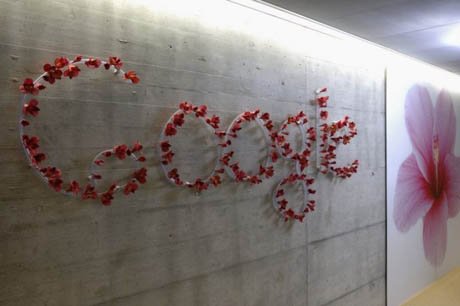
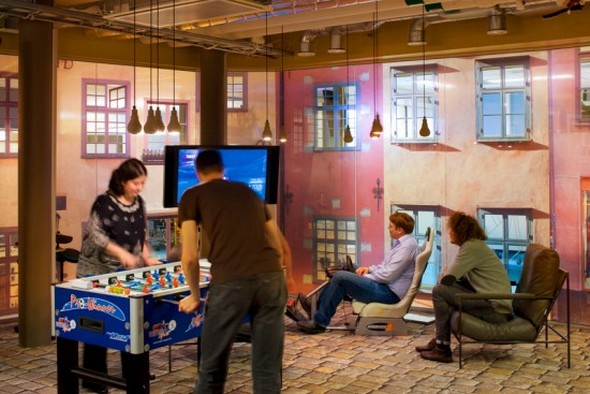
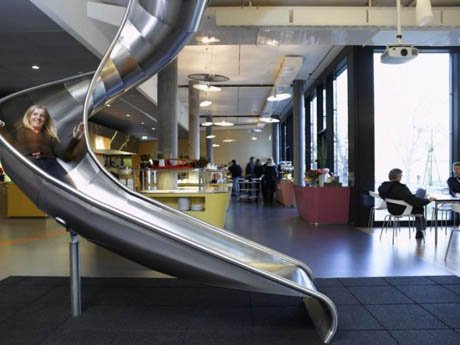
Because of the “Millennials” (people born in the1980’s and 1990’s) the work place is changing.  We are seeing a push towards a much more casual atmosphere. One of the most extreme changes to the office environment is the way Google runs its company. They have almost completely done away with the cubicle open office system and adopted a very casual very playful office design.  Business meetings are conducted with everyone sitting in oversized bean bag chairs set in a semi- circle around a white board. In all of the pictures of the company’s office there are no long tables with neatly positioned chairs on both sides and the big boss’s chair at the end presiding over all the rest like we have seen in the past. This is because Google does not run their company that way. Although there are people in charge they are sharing the same work stations there is no hierarchy design layout to their offices.  The company has plenty of spaces for the “googlers” (what Google calls their employees) to relax while they are at work. For example their Zurich office sports a game room with foosball and pool tables as well as a message center.  Although Google may be an extreme case of a modern office we are seeing offices changing to a more relax less restricted design layout.
                Although Google may be an extreme case of a fun relaxed hip modern office it does seem that office design is changing.  Instead of long conference tables we will probably start seeing round ones where there is no head of the table everyone shares ideas and is equal to everyone at the table. Because of technology like laptops and netbooks there is less of a need for everyone to use a desk with a desktop computer. I believe we will absolutely see a push towards many companies designing sustainable offices like what Herman Miller has done with their company.  Times are changing in with them so is design. As future designers it is our job to learn about the new products and new ideas for the millennial office environment.
(to view more from the website I chose these from click on the images)
 ofis_google_v_cjurikhe_50_foto_32.jpg
Google office design
ofis_google_v_cjurikhe_50_foto_6.jpg

Here is a list of sites I browsed on this topic if you would like to read more about this subject:


Saturday, September 11, 2010

Welcome

Hi Everyone!! Welcome to my blog there isnt much here yet its still a work in progess. I am going to try to put some of my work up this week. So I hope you come back to check out my stuff and thanks for reading!

-Marissa

p.s. if anyone knows how I can allow people to follow my blog please let me know apparently that still isnt working